
E-commerce and Digital Marketing
The growth of the internet has completely changed the way people discover, compare, and purchase products and services. Today, customers can shop from their smartphones, laptops, and other digital devices without visiting a physical store. This development has created enormous opportunities for businesses through e-commerce.
However, simply creating an online store is not enough to attract customers. Businesses need to make people aware of their products, build trust, communicate with potential customers, and encourage them to make purchases. This is where digital marketing becomes essential.
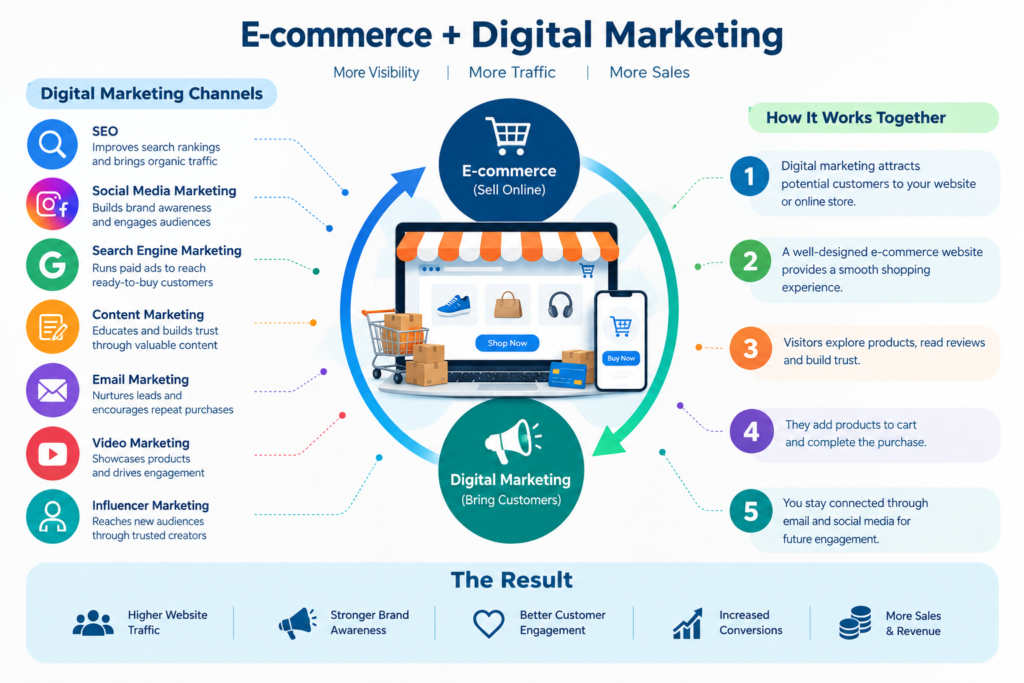
E-commerce and digital marketing work together to create a complete online business strategy. E-commerce provides the platform where customers can purchase products, while digital marketing helps bring the right customers to that platform.
Table of Contents
1. What Is E-commerce?
E-commerce and Digital Marketing or electronic commerce, refers to buying and selling products or services through the internet. Instead of visiting a physical shop, customers can browse products online, select what they want, make payments digitally, and receive their orders at their preferred location.
E-commerce and Digital Marketing can include everything from small online businesses to large international marketplaces. Businesses can sell physical products, digital products, subscriptions, services, and more through e-commerce platforms.
Examples of E-commerce
Some common examples include:
- Online clothing stores
- Grocery websites
- Electronics stores
- Beauty and cosmetics websites
- Food delivery platforms
- Online bookstores
- Digital product stores
- Online service businesses
- Subscription-based businesses
E-commerce provides convenience to both businesses and customers. Customers can shop at any time, while businesses can reach customers beyond their local geographical area.
2. How Does E-commerce Work?
E-commerce involves several important steps that work together to complete an online purchase.
Step 1: Product Display
The business displays its products on a website or online marketplace. Product pages generally contain images, descriptions, prices, specifications, reviews, and other useful information.
Step 2: Customer Search
Customers search for products using search engines, social media, advertisements, marketplaces, or direct visits to an online store.
Step 3: Product Selection
Customers compare different products and select the items they want to purchase.
Step 4: Online Payment
The customer completes the purchase using payment methods such as credit cards, debit cards, UPI, net banking, wallets, or other available payment options.
Step 5: Order Processing
The business receives the order, prepares the product, and arranges delivery.
Step 6: Delivery and Customer Support
The product reaches the customer, and the business may provide customer support for questions, returns, exchanges, or complaints.
This entire process depends on a combination of technology, online platforms, payment systems, logistics, customer service, and marketing.
3. What Is Digital Marketing?
Digital marketing is the promotion of products, services, or brands through digital channels such as search engines, websites, social media, email, online advertising, and other internet-based platforms.
Traditional marketing may use newspapers, television, radio, magazines, and physical advertisements. Digital marketing focuses on reaching customers through the digital platforms they use every day.
For an e-commerce business, digital marketing is particularly important because customers usually discover products online before purchasing them.
4. Major Types of Digital Marketing
Digital marketing includes several different strategies.
Search Engine Optimization (SEO)
SEO helps websites appear higher in search engine results. For example, if someone searches for “best handmade pickles online,” an optimized e-commerce website has a better opportunity to appear in relevant search results.
SEO can increase organic traffic without requiring payment for every visitor.
Social Media Marketing
Social media marketing promotes products and brands through platforms such as Instagram, Facebook, YouTube, and other social networks.
Businesses can publish:
- Product photos
- Videos
- Reels
- Customer reviews
- Offers
- Educational content
- Behind-the-scenes content
Social media can help businesses build relationships with potential customers.
Search Engine Marketing
Search engine advertising allows businesses to display paid advertisements when users search for specific products or services. This can help an e-commerce business reach customers who already have purchase-related intentions.
Content Marketing
Content marketing involves creating useful and informative content to attract customers.
Examples include:
- Blog articles
- Product guides
- Buying guides
- Videos
- Tutorials
- Infographics
- Frequently asked questions
Good content can educate customers and establish a business as a knowledgeable and trustworthy brand.
Email Marketing
Email marketing allows businesses to communicate directly with customers. Businesses can send product recommendations, new-product announcements, special offers, reminders, and useful information.
Influencer Marketing
Businesses can collaborate with influencers or content creators to introduce products to their audiences. This can be particularly useful for fashion, beauty, food, lifestyle, and other consumer-focused businesses.
Video Marketing
Videos can demonstrate products more effectively than text alone. Product demonstrations, tutorials, reviews, and short-form videos can help customers understand products before purchasing.
5. Why Does E-commerce Need Digital Marketing?
An online store can have excellent products, attractive prices, and a professional website, but customers cannot purchase from it if they do not know it exists.
This is the main reason E–commerce and Digital Marketing
Digital marketing helps an e-commerce business attract visitors, create awareness, build trust, increase sales, and maintain relationships with customers.
6. Digital Marketing Helps E-commerce Reach More Customers
A physical store generally depends on customers who live nearby or visit its location. An e-commerce business can reach customers across cities, states, countries, and potentially global markets.
E-commerce and Digital Marketing makes this wider reach possible.
For example, an online clothing business can use social media advertisements to show its products to people interested in fashion. Similarly, an online food business can use SEO and social media to reach customers searching for specific food products.
Therefore, E-commerce and Digital Marketing
allows e-commerce businesses to reach audiences beyond their physical location.
7. It Increases Website Traffic
A beautiful e-commerce website is not useful if nobody visits it.
E-commerce and Digital Marketing brings visitors to the online store through different channels.
SEO can bring visitors from search engines. Social media can send users to product pages. Paid advertising can generate immediate traffic. Email marketing can bring existing customers back to the website.
More relevant website traffic creates more opportunities for sales of E-commerce and Digital Marketing
However, the goal should not simply be to generate large amounts of traffic. Businesses should focus on attracting relevant customers who are genuinely interested in their products.
8. It Builds Brand Awareness
Customers often see many similar products online. A strong brand can help an e-commerce business stand out.
E-commerce and Digital Marketing Regular content on social media, search engines, websites, and other channels helps customers recognize and remember the brand.
Over time, consistent E-commerce and Digital Marketing
can turn an unfamiliar online store into a recognizable brand.
9. It Helps Build Customer Trust
Trust is extremely important in e-commerce because customers cannot physically examine a product before buying it.
E-commerce and Digital Marketing
can help businesses demonstrate credibility through:
- Customer reviews
- Testimonials
- Product demonstrations
- Professional website design
- Educational content
- Social media presence
- Clear product information
- Transparent policies
Positive customer experiences can also encourage existing customers to recommend the business to others.
When customers trust a brand, they are more likely to purchase from it.
10. Digital Marketing Helps Target the Right Audience
One of the biggest advantages of digital marketing is audience targeting.
An E-commerce and Digital Marketing can create campaigns based on factors such as:
- Customer interests
- Search behavior
- Location
- Age groups
- Previous website activity
- Purchase behavior
- Engagement with content
For example, a business selling skincare products can create content specifically for people interested in skincare and beauty.
Targeted marketing helps businesses avoid spending their entire advertising budget on people who are unlikely to become customers in to E-commerce and Digital Marketing
11. It Increases Online Sales
The ultimate objective of most e-commerce businesses is to generate sales.
Digital marketing can guide customers through different stages of the buying journey.
A customer may first discover a product through social media. Later, they may search for reviews on Google. They may then visit the website and compare products. Finally, they may purchase the product after seeing an offer or receiving a reminder.
Digital marketing supports each stage of this journey.
12. It Helps Businesses Understand Customers
Digital marketing provides valuable information about customer behavior.
Businesses can analyze information such as:
- Which products receive the most attention
- Which pages customers visit
- How customers find the website
- Which advertisements generate results
- Which content receives engagement
- Where customers leave the purchasing process
This information helps businesses make better decisions.
Instead of relying only on assumptions, businesses can use digital performance data to improve their marketing strategies.
13. It Supports Customer Retention
Getting a new customer is important, but keeping existing customers can also be highly valuable.
Digital marketing allows e-commerce businesses to stay connected with previous customers through email, social media, personalized offers, product recommendations, and useful content.
For example, after a customer purchases a product, a business can provide care instructions, related product recommendations, or information about new products.
Maintaining relationships can encourage customers to return for future purchases.
14. Digital Marketing Is Cost-Effective
Traditional advertising can sometimes require a large budget, especially for television, newspapers, billboards, and other offline channels.
Digital marketing offers businesses different budget options. A small business can begin with organic social media content, SEO, email marketing, and other affordable strategies.
Paid campaigns can also be adjusted according to the available budget.
The important factor is to focus on marketing activities that provide meaningful results rather than spending money without measuring performance.
15. E-commerce and SEO: A Powerful Combination
SEO is particularly important for e-commerce websites because customers frequently use search engines to find products.
A strong e-commerce SEO strategy can include:
- Keyword research
- Optimized product titles
- Product descriptions
- Image optimization
- Category-page optimization
- Internal linking
- Helpful blog content
- Mobile-friendly design
- Fast website performance
- Technical SEO
For example, instead of simply naming a product “Pickle,” an online store could create a more descriptive and search-friendly product page such as “Homemade Mango Pickle – Traditional South Indian Style.”
The goal is to make product pages useful for both search engines and customers.
16. Social Media and E-commerce
Social media has become an important channel for discovering products.
Visual platforms are particularly useful for businesses selling products where appearance influences purchasing decisions. Fashion, beauty, food, home décor, and handmade products can benefit from attractive photos and videos.
Businesses can use social media to:
- Introduce new products
- Share offers
- Publish customer reviews
- Demonstrate products
- Answer customer questions
- Build a community
- Direct customers to their online store
Consistent and valuable content can help turn social media followers into E-commerce and Digital Marketing potential customers. E-commerce and Digital Marketing
17. The Role of Content in E-commerce Marketing
Content is another important part of digital marketing.
Customers often have questions before purchasing. Useful content can provide answers and reduce uncertainty.
For example, an electronics store can publish a guide explaining how to choose a laptop. A beauty store can publish E-commerce and Digital Marketing skincare tips. A food business can explain how its products are made.
This type of content can attract people who are researching before making a purchase.
Good content should focus on helping customers, not only selling products.
18. Challenges of Digital Marketing for E-commerce
Although digital marketing provides many opportunities, e-commerce E-commerce and Digital Marketing businesses also face challenges.
High Competition
Thousands of businesses may sell similar products online. Standing out requires strong branding and valuable content.
Changing Customer Behavior
Online trends can change quickly. Businesses need to understand changing customer expectations and adapt their strategies.
Increasing Advertising Costs
Paid advertising can become expensive in competitive industries.E-commerce and Digital Marketing Businesses need to monitor campaigns carefully.
Maintaining Customer Trust
Negative reviews, poor service, delayed deliveries, or unclear product information can damage a brand’s reputation.
Website Experience
A slow, confusing, or difficult-to-use website can cause customers to leave before completing a purchase.
19. Best Digital Marketing Strategy for an E-commerce Business
A successful e-commerce marketing strategy should combine several digital channels rather than depending on only one.
A business can follow this approach:
Step 1: Understand the target audience.
Step 2: Create a professional and mobile-friendly e-commerce website.
Step 3: Research relevant keywords and optimize product pages.
Step 4: Build a consistent social media presence.
Step 5: Create useful blogs, videos, and product content.
Step 6: Use paid advertising when appropriate.
Step 7: Collect customer reviews and testimonials.
Step 8: Use email marketing to maintain customer relationships.
Step 9: Track website traffic, engagement, conversions, and sales.
Step 10: Improve the strategy based on performance data.
This approach creates a continuous marketing cycle in which businesses attract, engage, convert, and retain customers E-commerce and Digital Marketing.
20. Future of E-commerce and Digital Marketing
The relationship between e-commerce and digital marketing will continue to grow as more consumers use digital platforms for shopping.
Businesses are increasingly focusing on mobile shopping, personalized experiences, short-form videos, socialE-commerce and Digital Marketing commerce, artificial intelligence, automation, and data-driven marketing.
Customers also expect faster communication, convenient payment options, easy navigation, useful information, and reliable customer service.
Therefore, e-commerce businesses that combine a strong online store with effective digital marketing will have better opportunities to compete in the changing digital marketplace.
Conclusion
E-commerce and digital marketing are closely connected. E-commerce provides the online environment where customers purchase products and services, while digital marketing helps businesses attract customers to that environment.
A successful e-commerce business requires more than simply listing products on a website. It needs visibility, trust, customer engagement, valuable content, strong branding, and continuous communication.
Digital marketing helps businesses achieve these goals through SEO, social media marketing, content marketing, email marketing, online advertising, video marketing, and other digital strategies.
In today’s competitive online marketplace, businesses that understand their customers and use digital marketing effectively can improve their visibility, build stronger relationships, increase website traffic, and create more opportunities for sales.
Ultimately, e-commerce gives businesses a place to sell, while digital marketing helps customers find, trust, and choose the business.
-commerce, also known as electronic commerce, refers to buying and selling products or services through the internet. It allows businesses to display products, accept orders, receive payments, and communicate with customers online.
Unlike traditional stores, e-commerce businesses can serve customers beyond their local areas.E-commerce and Digital Marketing Customers can browse product categories, compare prices, read reviews, and place orders at their convenience.
There are several types of e-commerce businesses:
- Business-to-Consumer (B2C): Businesses sell products directly to customers.
- Business-to-Business (B2B): Businesses sell products or services to other businesses.
- Consumer-to-Consumer (C2C): Individuals sell products to other individuals through online marketplaces.
- Consumer-to-Business (C2B): Individuals offer products or services to businesses.
For example, a small business selling homemade pickles can create an e-commerce website to showcase its products, E-commerce and Digital Marketingdisplay prices, accept orders, and deliver products to customers. With the right digital marketing strategy, the business can attract customers who are searching for traditional homemade foods.
2. Why Is Digital Marketing Important for E-commerce?
Digital marketing plays an important role in the E-commerce and Digital Marketing success of an e-commerce business. Even if a website offers excellent E-commerce and Digital Marketing products, customers may not discover it without effective promotion.
Digital marketing helps businesses reach people who are interested in their products and services. It also creates opportunities E-commerce and Digital Marketingto build brand awareness, communicate with customers, and encourage repeat purchases.
The major benefits of digital marketing for e-commerce include:
Increased online visibility: SEO and digital advertising help customers discover products through search engines and online platforms.
Better audience targeting: Businesses can create campaigns for specific audiences based on relevant interests, locations, and other available targeting options.
Cost flexibility: Businesses can select marketing methods according to their budgets and goals.
Improved customer relationships: Social media, email marketing, and helpful content allow businesses to communicate with customers.
Measurable performance: Website analytics and advertising reports help businesses understand E-commerce and Digital Marketing which activities generate traffic, enquiries, and sales.
A well-planned digital marketing strategy enables e-commerce businesses to make informed decisions and improve their online performance.
3. Search Engine Optimization for E-commerce Websites
Search engine optimization is one of the most valuable long-term strategies for an online store. SEO helps improve a website’s visibility in organic search results when customers look for relevant products or information.
For example, a customer searching for “homemade mango pickle online” may discover a store that has useful product pages, relevant content, and a technically accessible website.
To improve e-commerce SEO, businesses should focus on the following activities.
Keyword Research
Keyword research identifies the words and phrases potential E-commerce and Digital Marketing customers use when searching online. Choose relevant keywords for product pages, category pages, and blog articles.
For example, an online clothing store might target phrases such as “women’s ethnic wear online” or “cotton kurtis for women.”
Use keywords naturally in page titles, headings, product descriptions, and URLs. Avoid repeating keywords excessively, as this can make content difficult to read.
Product Page Optimization
Every product page should contain a clear product name, original description, useful images, accurate pricing, and relevant details. Include information about materials, sizes, ingredients, or usage wherever appropriate.
Unique and helpful descriptions improve the customer experience and help search engines understand the page.
Technical SEO
Technical SEO helps search engines access and understand a website. Important factors include mobile usability, website speed, secure HTTPS connections, crawlable links, and an accurate XML sitemap.
A technically sound website makes it easier for customers to browse products and complete purchases.
4. Social Media Marketing for Online Stores
Social media marketing helps e-commerce businesses introduce products, engage with customers, and develop brand awareness. Platforms such as Instagram, Facebook, Pinterest, and YouTube provide different ways to showcase products and share useful content.
Businesses can publish product photographs, short videos, demonstrations,E-commerce and Digital Marketing customer testimonials, behind-the-scenes content, and seasonal promotions.
For example, a beauty business can publish makeup tutorials and skincare tips, while a homemade food business can share preparation videos, serving suggestions, and product photographs.
To make social media marketing effective:
- Select platforms that suit your target audience.
- Maintain a consistent brand identity.
- Publish useful and engaging content regularly.
- Respond professionally to questions and comments.
- Share accurate product details and pricing.
- Track engagement, website visits, and sales where possible.
Social media success is not only about gaining followers. The main objective is to build trust and encourage meaningful interactions that support business goals.
5. Content Marketing to Attract Customers
Content marketing involves creating helpful and relevant material that informs customers and supports their purchasing decisions.
For e-commerce businesses, content can include blog posts, buying guides, product comparisons, tutorials, frequently asked questions, and educational videos.E-commerce and Digital Marketing
For example, an online electronics store could publish an article explaining how to choose a laptop for students. A food business could create a guide to storing homemade pickles properly.
Useful content helps answer customer questions before they purchase a product. It can also attract organic search traffic and establish a business as a helpful source of information.
A successful content marketing plan should focus on customer needs rather than simply promoting products. Identify common questions, organize topics into categories, and publish accurate content that provides practical value.
Include relevant internal links to product pages and related articles so readers can explore more information.
6. Website Design and User Experience
A professional e-commerce website should be visually appealing, easy to navigate, and convenient to use. Website design influences how customers perceive a business and how easily they can find products.E-commerce and Digital Marketing